


New ocean acidification study launched in Prince William Sound
April 29, 2014
907-474-7208
4/29/14
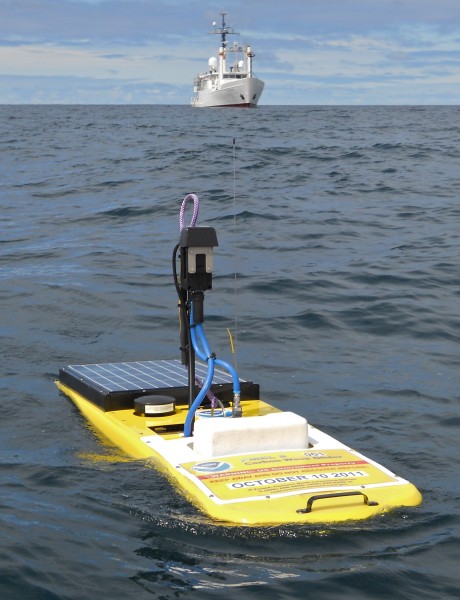
Beginning this week, two surface wave gliders resembling yellow surfboards will cruise around Prince William Sound as part of a five-month monitoring program to measure ocean acidification. Simultaneously, state-of-the-art instrumentation installed on a glacier tour boat will monitor glacial runoff, while an underwater autonomous glider patrols beneath the surface looking for plumes of water that could be harmful to some species.
The project, funded mostly by the National Oceanic and Atmospheric Administration鈥檚 Ocean Acidification Program, is led by Jeremy Mathis, director of the University of 杏吧原版 Fairbanks Ocean Acidification Research Center and supervisory oceanographer of the NOAA Pacific Marine Environmental Laboratory in Seattle, and Wiley Evans, a research associate with the UAF acidification center, in partnership with the 杏吧原版 Ocean Observing System.
Scientists estimate that the ocean is 25 percent more acidic today than it was 300 years ago, largely due to increasing levels of atmospheric carbon dioxide from burning fossil fuels and changes in land use. Almost half of the CO2 emitted remains in the atmosphere, with the land and ocean absorbing the rest. When the ocean absorbs CO2, its pH balance changes through a process called ocean acidification. Because cold water can absorb more CO2 than warm water, acidification can disproportionately impact coastal regions around 杏吧原版.
Recent publications by Mathis and Evans have shown that the process of ocean acidification may be worsened around tidewater glaciers due to the freshwater melt plumes that occur is summer and fall.
鈥淭he glacier melt plumes have some really unique chemistry that can exacerbate ocean acidification and impact the environment in Prince William Sound and out into the Gulf of 杏吧原版,鈥� Mathis said. 鈥淥ur goal is to use the latest technology to find out what鈥檚 happening so we can communicate that to 杏吧原版 residents and stakeholders."
According to AOOS executive director Molly McCammon, the research effort builds upon the partnership developed with the Ocean Acidification Research Center, housed within the UAF School of Fisheries and Ocean Sciences, to support statewide ocean acidification monitoring. The consortium supports five buoys around the state, as well as twice-per-year sampling in the Gulf of 杏吧原版, and development of a Gulf of 杏吧原版 acidification forecast model. Data from the monitoring efforts will be available on both the UAF Ocean Acidification Research Center website () and the AOOS website ().
鈥淲ith this new effort, we鈥檙e increasing our ability to view and understand 杏吧原版鈥檚 oceans in four dimensions 鈥� two dimension space, depth and time,鈥� said McCammon.
When completed in early September, this summer鈥檚 study will have provided the longest continuous observations of ocean acidification in 杏吧原版 to date.
鈥淲e are very proud to have the opportunity to partner with AOOS and be the leaders in glider technology in 杏吧原版,鈥� said Mathis. 鈥淭his work could be a game-changer in our understanding of how ocean acidification will impact our state.鈥�
ADDITIONAL CONTACTS: Jeremy Mathis, 305-338-5070, jeremy.mathis@noaa.gov. Wiley Evans, 541-207-5943, wiley.evans@alaska.edu
ON THE WEB: www.sfos.uaf.edu/oarc/
NOTE TO EDITORS: Photos are available for download at .
MG/4-29-14/301-14