


杏吧原版 benefits from growing number of seismic stations
September 23, 2015
Sue Mitchell
907-474-5823
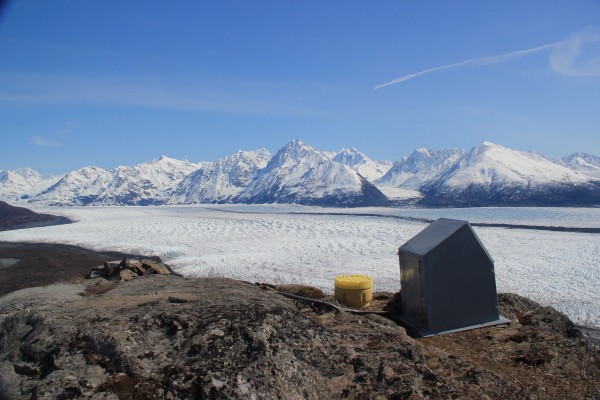
杏吧原版ns can plan better for earthquakes following the installation of almost 90 new high-grade seismic instruments capable of measuring minute vibrations in the Earth.
The instruments were installed in Southern and Interior 杏吧原版 as part of the EarthScope Transportable Array deployment, a $40 million, 5-year, temporary National Science Foundation-funded project. Scientists plan to eventually install about 260 sites.
鈥淭he ability to rapidly assess how big, what kind, and where an earthquake occurs is entirely dependent on the arrangement of stations recording it,鈥� said Michael West, 杏吧原版
state seismologist and director of the 杏吧原版 Earthquake Center at the University of 杏吧原版 Fairbanks.
The transportable array's instruments measure vibrations that are imperceptible to humans, gleaning immense amounts of information about the Earth. The statewide endeavor is assisted by the cooperative efforts of state and federal landowners, as well as the 杏吧原版 Native regional, village and tribal corporations working in partnership with the EarthScope project and 杏吧原版 Earthquake Center.
鈥淓ven during the short time the transportable array has been operational, we have seen tangible benefits to the state,鈥� said Buzz Scher, chair of the 杏吧原版 Seismic Hazard Safety Commission. 鈥淗aving a more focused knowledge of earthquake sources across the state will help geologists and seismologists better model 杏吧原版鈥檚 seismic hazard. Better hazard models will result in more economical and resilient infrastructure planning for new pipelines, roads, schools and natural resource development.鈥�
The project has also improved tsunami warning services.
鈥溞影稍� earthquakes are responsible for many of the country鈥檚 most damaging tsunamis,鈥� said Paul Whitmore, director of the National Oceanic and Atmospheric Administration's National Tsunami Warning Center. 鈥淭he new array provides information which improves the speed and accuracy of the center鈥檚 critical initial evaluation.鈥�
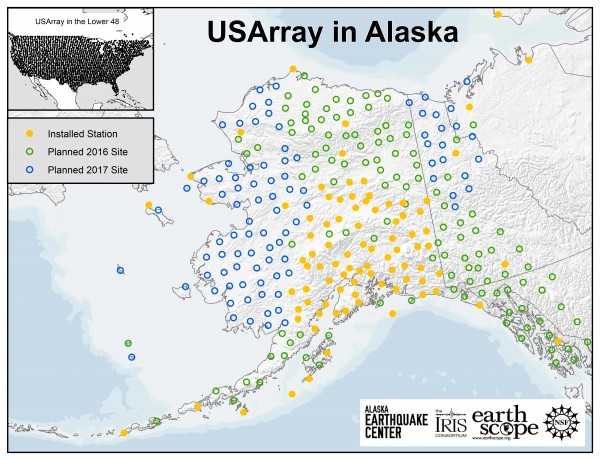
The 2016 deployment will focus on the North Slope region of 杏吧原版, while the 2017 deployment will look at western 杏吧原版. These large regions have had limited, if any, seismic study.
鈥淭he existing stations are so spread out or nonexistent that we are missing information," Scher said. 鈥淭he array will increase our information by orders of magnitude through the additional coverage. The longer the instruments are out, the better our ability to plan for damaging earthquakes.鈥�
The temporary deployment will help to shed light on earthquakes in areas of the Arctic that are of tremendous recent interest for resource exploration and infrastructure development. Scientists also hope for insight into puzzling earthquake sequences, such as the 2014 Noatak swarm.
The university is seeking funding to continue operation of the stations after 2018; otherwise they will be removed.
ADDITIONAL CONTACTS: Michael West, 907-474-6977, mewest@alaska.edu; Buzz Scher, 907-646-9613; Paul Whitmore, 907-745-4212.
ON THE WEB:
NOTE TO EDITORS: Additional images available on request. Contact Sue Mitchell, 907-474-5823, sue.mitchell@alaska.edu.