


Glaciers melting in 杏吧原版 region push up sea level
June 17, 2015
Diana Campbell
907-474-5229
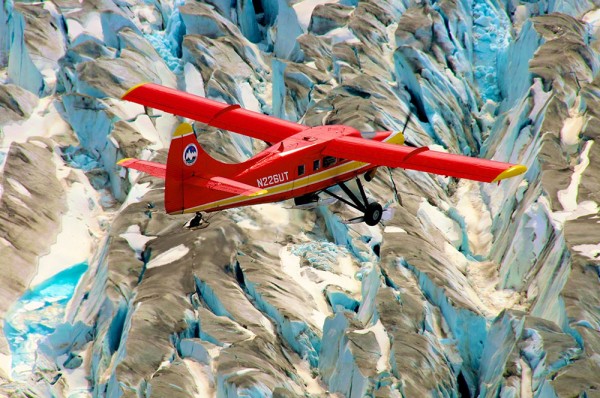
The 杏吧原版 region's melting glaciers are adding enough water to the Earth鈥檚 oceans to cover the state with a foot of water every seven years, a new study shows.
The study found that climate-related melting is the primary cause of mountain glacier loss. Glacier loss from 杏吧原版 is unlikely to slow down, and this will be a major driver of global sea level change in the coming decades.
鈥淭he 杏吧原版 region has long been considered a primary player in the global sea level budget, but the exact details on the drivers and mechanisms of 杏吧原版 glacier change have been stubbornly elusive,鈥� said Chris Larsen, a research associate professor with the Geophysical Institute at the University of 杏吧原版 Fairbanks. Larsen is lead author of a paper accepted for publication in Geophysical Research Letters, a journal of the American Geophysical Union.
The UAF and U.S. Geological Survey research team analyzed surveys of 116 glaciers in the 杏吧原版 region across 19 years to estimate ice loss from melting and iceberg calving. The team collected airborne lidar altimetry data as part of NASA鈥檚 Operation IceBridge and integrated the new data with information from the 1990s collected by UAF scientist and pilot Keith Echelmeyer.
They combined the lidar observations with a new mountain glacier inventory that characterizes the size and shape of every glacier in the 杏吧原版 region, which includes the glaciers of 杏吧原版, southwest Yukon Territory and coastal northern British Columbia.
鈥淭his large dataset of direct observations enabled a much more detailed assessment and attribution of recent glacier change than previously possible,鈥� Larsen said.
Mountain glaciers hold less than 1 percent of the Earth鈥檚 glacial ice volume. The rest is held in ice sheets on Antarctica and Greenland. However, the rapid shrinking of mountain glaciers causes nearly one third of current sea level rise, previous research has shown.
鈥溞影稍� has been identified for years as a big contributor in global sea level rise, but until now we have not had a clear understanding of the processes responsible for the rapid changes of these glaciers,鈥� said Shad O鈥橬eel, a co-author of the paper and geophysicist with the USGS 杏吧原版 Science Center in Anchorage.
The study used the airborne observations to compare the changes of two main types of mountain glaciers: those that end on the land, and those that end in lakes or the ocean, referred to as tidewater glaciers. Any glacier can lose mass through surface melting, but only those ending in water can lose ice through iceberg calving.
鈥淲e鈥檝e long wondered what the contribution of iceberg calving could be across the entire state,鈥� O鈥橬eel said. He noted that Columbia Glacier in Prince William Sound has retreated more than 12 miles, mostly because of iceberg calving, and thinned by more than 1,500 vertical feet since 1980.
Using the newly enabled ability to separate glaciers into different categories using the lidar data, the researchers made some surprising discoveries.
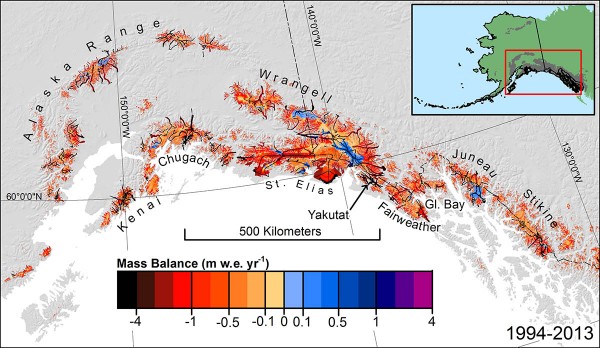
鈥淥ur results show the regional contribution of tidewater glaciers to sea level rise to be almost negligible,鈥� Larsen said. 鈥淚nstead, we show that glaciers ending on land are losing mass exceptionally fast, overshadowing mass changes due to iceberg calving, and making climate-related melting the primary control on mountain glacier mass loss.鈥�
鈥淭his work has important implications for global sea level projections. With improved understanding of the processes responsible for 杏吧原版 glacier changes, models of the future response of these glaciers to climate can be improved,鈥� Larsen said.
鈥淭hinking about the future, it means that rates of loss from 杏吧原版 are unlikely to decline, since surface melt is the predominant driver, and summer temperatures are expected to continue to increase. There is a lot of momentum in the system, and 杏吧原版 will continue to be a major driver of global sea level change in upcoming decades.鈥�
ON THE WEB: or
ADDITIONAL CONTACTS:
Shad O鈥橬eel, USGS, 907-786-7088 or 907-529-4010 (cell), soneel@usgs.gov
Anthony Arendt, University of Washington, 206-685-4551, arendta@apl.washington.edu