


New ocean invader spotted in 杏吧原版
October 8, 2018
Paula Dobbyn
907-274-9698
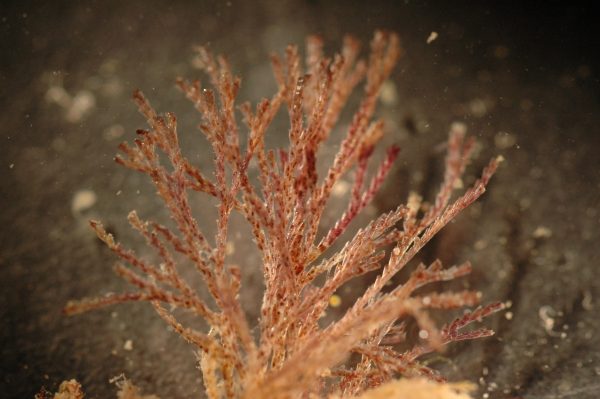
Scientists and local volunteers have detected a new invasive species in the waters of Southeast 杏吧原版.
鈥檚 Gary Freitag, agent in Ketchikan, is a member of the scientific team that discovered Bugula neritina, an invertebrate filter feeder also referred to as a branching bryozoan. These tiny organisms form colonies and are sometimes called moss animals or sea lace.
鈥淭hey鈥檙e very aggressive. They have the potential to rob native species of food and oxygen. Some marine invasive species, such as colonial tunicates, have been known to wipe out shellfish beds, killing valuable species like oysters and clams,鈥� said Freitag.
The scientific team included researchers from the , and the University of 杏吧原版 Fairbanks College of Fisheries and Ocean Sciences. 杏吧原版 Sea Grant is housed within UAF and is a partnership with the .
Beside Bugula neritina, the scientific team documented the continuing spread of three other non-native species in the Ketchikan region. The other invaders are tunicates, invertebrates often called sea squirts. Two of these tunicate species, the golden star and chain tunicate, appear to be spreading in waters around Ketchikan at the southern end of 杏吧原版鈥檚 panhandle.
The were published last month in Bioinvasions Records, a peer-reviewed, international academic journal.
Marine invasive species are a threat to 杏吧原版鈥檚 fishing, aquaculture and tourism industries, as well as to cultural and traditional activities such as subsistence shellfish harvesting.
The recent discoveries of Bugula neritina and invasive tunicates marked the culmination of years of observation not only by professional scientists like Freitag, but also by Ketchikan-area volunteers. In 2003, a group of Smithsonian scientists conducted an initial survey of Ketchikan and noticed the chain tunicate. Four years later, a citizen-science monitoring program called Plate Watch got started. Citizen scientists 鈥� including a teacher and students from a nearby high school 鈥� have documented the chain tunicate鈥檚 spread ever since.
The invasive species are thought to have arrived in 杏吧原版 by vessel traffic. Ketchikan is the first stop in 杏吧原版 for large, foreign-flagged cruise ships as well as other marine vessels, such as barges and fishing vessels, heading north.
鈥淰essel traffic is increasing in 杏吧原版. These ships and boats can carry organisms from foreign ecosystems into 杏吧原版 waters, where they have the potential to cause significant problems,鈥� said Freitag.
Making the public aware of the growing presence of marine invasive species is the first step toward curbing the problem. Climate change and warming ocean temperatures are likely to exacerbate the issue, making the need for increased citizen monitoring that much more urgent, he said.
The journal article can be found . Downloadable images and captions can be accessed .
ADDITIONAL CONTACT: Gary Freitag, 907-617-8990, gary.freitag@alaska.edu
ON THE WEB: