


North Korea blast lights up 杏吧原版 seismometers
September 7, 2017
Ned Rozell
907-474-7468
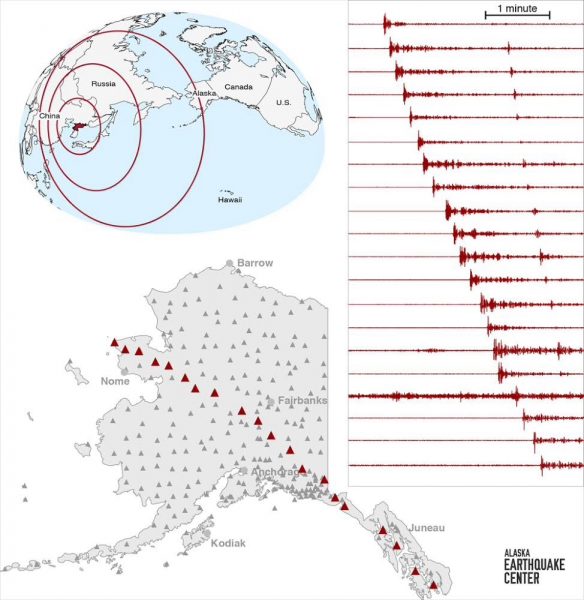
On Saturday night, Sept. 2, Matt Gardine was at home outside Fairbanks playing with his daughter when his phone beeped. As the seismologist on call with the 杏吧原版 Earthquake Center, Gardine鈥檚 duty was to get information out about detectable earthquakes right after they happen.
A few minutes earlier, at 7:30 p.m., a wave of energy had passed through 杏吧原版. The shake had propagated through the entire planet, first reaching 杏吧原版 near the village of Wales and racing southeast from there.
Looking at the waveform that registered on seismometers from Tin City to Ketchikan, Gardine noticed its squiggle signature did not look like an earthquake. He saw its origin was North Korea, which doesn鈥檛 have many large earthquakes. He also thought it curious that the disturbance occurred right on the half hour, at 7:30.
Though people in China and Russia reported feeling a shake, which U.S. Geological Survey scientists estimated as magnitude 6.3 at its source in North Korea, Gardine suspected no 杏吧原版ns would detect the movement and that it was not an earthquake. He issued no alerts.
The shake that registered on 杏吧原版 seismometers and most sensitive instruments worldwide was an underground nuclear explosion by North Koreans. Since the Comprehensive Nuclear-Test-Ban Treaty in 1996, North Korea has been the only country conducting these tests.
鈥淚t was almost certainly underground,鈥� Gardine said. 鈥淭hey did it to test that they can detonate a bomb, that their bombs are good.鈥�
Detecting nuclear explosions is not the job of the researchers who work at the 杏吧原版 Earthquake Center, based at the university in Fairbanks. There is an Air Force agency, the Technical Applications Center, with that responsibility.
But Mike West, 杏吧原版's state seismologist, said he and others at the center are 鈥渟cientifically deeply interested鈥� in the blasts. More than 400 seismometers planted around 杏吧原版 have registered two North Korea tests last year and one in 2015. Seismometers all over North America caught the same signals a few minutes later.
Underground explosions register with more clarity than earthquakes, West said. The recent burst was also followed by a second, smaller energy spike that was one of the reasons West invited all scientists to a post-Labor Day gathering to discuss the blast. The second signal was the energy of the nuclear bomb bouncing off the outer core of the Earth and returning to seismometers.
The North Korean bomb was a small blast compared to one in 杏吧原版 on Nov. 6, 1971. That鈥檚 when U.S. Atomic Energy Commission officials executed the largest underground nuclear test ever done in America. That 5-megaton bomb, named project Cannikin, was detonated in a shaft more than one mile deep beneath Amchitka Island in the western Aleutians.
Since the late 1970s, the University of 杏吧原版 Fairbanks' Geophysical Institute has provided this column free in cooperation with the UAF research community. Ned Rozell is a science writer for the Geophysical Institute.